
You can be physically alive and still need spiritual life.
You can breathe, think, work, raise a family, and accomplish extraordinary things while remaining separated from God.
Understanding the difference between physical death and spiritual death opens a deeper understanding of why Jesus said, “You must be born again.”
To understand what Jesus came to restore, we must return to Adam.
1. Adam’s separation began before his body stopped breathing.
“For in the day that thou eatest thereof thou shalt surely die.”
Genesis 2:17, KJV
Adam ate, but he did not immediately fall to the ground. His heart continued beating. His mind continued functioning. Yet his relationship with God had changed.
He hid. He became afraid. Shame entered the place where he had known openness with God.
In the Christian understanding of spiritual death as separation from God, Adam’s experience reveals a sobering truth: a person can remain physically alive while becoming spiritually alienated from the source of life. His disobedience also brought him under the sentence of physical death.
Spiritual death does not mean the spirit disappears. It describes separation from God’s life and fellowship.
2. Nine hundred and thirty years could not undo what happened in the garden.
“And all the days that Adam lived were nine hundred and thirty years: and he died.”
Genesis 5:5, KJV
Adam lived to be 930 years old. His physical death came long after his disobedience.
That distinction is an eye opener. Physical longevity, by itself, cannot restore spiritual fellowship. Neither can success, strength, possessions, or popularity.
You can have years ahead of you and still need new life within you.
Physical death involves the end of bodily life. Spiritual death describes alienation from God—even while bodily life continues.
That is why our greatest need reaches deeper than staying alive.
3. Jesus came to give us a birth we cannot produce ourselves.
“That which is born of the flesh is flesh; and that which is born of the Spirit is spirit. Marvel not that I said unto thee, Ye must be born again.”
John 3:6–7, KJV
Your natural birth brought you into this world. The new birth brings you into a new life with God.
Religious activity cannot manufacture it. Good intentions cannot earn it. Family connections cannot pass it down.
Through faith in Jesus Christ, we receive forgiveness and reconciliation. The Holy Spirit makes us alive to God and begins renewing us from within.
You cannot earn a birth. You receive life.
The call to be born again reaches beyond improving your public image. God addresses the inward person—the source from which your choices, desires, and relationships flow.
4. In Christ, you become a new creation.
“Therefore if any man be in Christ, he is a new creature: old things are passed away; behold, all things are become new.”
2 Corinthians 5:17, KJV
Some describe this as becoming “a new species of being.” The biblical expression is “new creation.” We remain human, but our relationship with God and the foundation of our identity are transformed.
Your past remains part of your story, but it no longer has the final word over who you are.
God’s life begins shaping your desires, choices, relationships, and responses. Growth takes time, but a new beginning has taken place.
Sometimes inward renewal becomes visible in a softened expression, a joyful smile, or a peaceful presence. More deeply, it becomes evident through love, patience, honesty, and compassion.
A believer can still experience grief, depression, illness, or exhaustion. A troubled face does not mean an empty spirit.
God’s life can sustain a person whose heart is hurting.
5. Your physical condition cannot tell the whole story of who you are.
“And I pray God your whole spirit and soul and body be preserved blameless unto the coming of our Lord Jesus Christ.”
1 Thessalonians 5:23, KJV
Paul speaks of spirit, soul, and body. Human life reaches beyond what we see in the mirror.
In the threefold understanding of humanity, your spirit is the inward dimension through which you relate to God; your soul includes your thinking, emotions, and will; your body gives you a physical presence in the world.
Scripture also pictures the body as an earthly tent our present dwelling. Yet the body remains a valuable part of God’s creation, worthy of care, and Christian hope includes its resurrection.
When we say, “The spirit is the real you,” we are emphasizing that your identity reaches deeper than your appearance, possessions, or physical abilities. God cares for your whole person.
This helps explain why someone—including an atheist—may consider life satisfactory without recognizing a need for spiritual rebirth. When physical existence and visible well-being are the measures being used, spiritual separation will not register as a problem.
That does not mean atheists lack kindness, purpose, or meaningful relationships. Christianity makes a further claim: every one of us needs reconciliation with God through Christ.
6. Jesus makes our response to Him the central issue.
“He that believeth on him is not condemned: but he that believeth not is condemned already, because he hath not believed in the name of the only begotten Son of God.”
John 3:18, KJV
These are serious words. Our need before God is already present, and Jesus comes as the Savior through whom we receive life.
Feeling comfortable cannot settle that spiritual question. Neither can comparing ourselves favorably with others.
The invitation is to trust Christ—to receive the grace we cannot earn and the life we cannot give ourselves.
7. Jesus is the way back to the Father.
“I am the way, the truth, and the life: no man cometh unto the Father, but by me.”
John 14:6, KJV
“I am the way.”
Jesus is the way into a restored relationship with the Father. Our accomplishments cannot bridge that separation. We come through Him, trusting His saving death and resurrection.
“I am the truth.”
Jesus reveals who God is and shows us our deepest need. His words call us to look beyond outward appearances and examine our relationship with the Father.
“I am the life.”
The spiritual life we need is found in Christ. Through Him, we receive forgiveness, fellowship with God, and eternal life—a relationship that begins now and continues beyond physical death.
“No man cometh unto the Father, but by me.”
Jesus places Himself at the center of reconciliation with God. The new birth rests on receiving Him, trusting His saving work, and allowing His Spirit to renew us.
Adam’s story reveals that a beating heart and spiritual fellowship are different realities. Jesus offers reconciliation and the promise of resurrection.
Your heartbeat confirms physical life. Your achievements describe what you have done. Jesus offers what neither can give you: eternal life with the Father.
You are more than the body people see. Your deepest need reaches beyond physical success.
You must be born again. This life cannot be earned. It is received through faith in Jesus Christ the way, the truth, and the life.
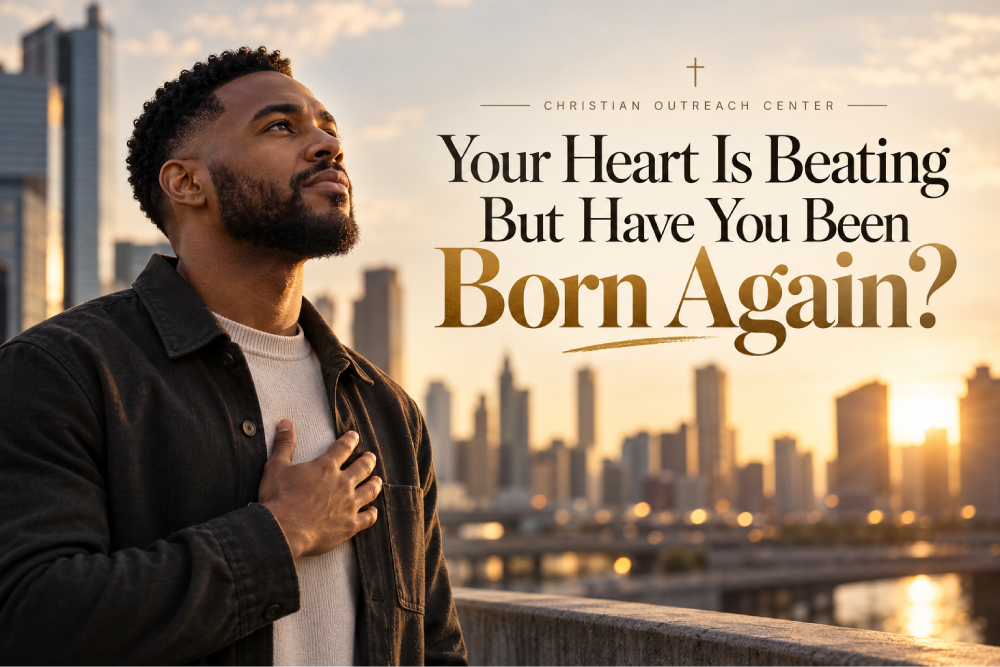
Your Heart Is Beating But Have You Been Born Again?
Need prayer or encouragement?
Connect with the COC family.

Join the Conversation